
Nine Flies I Still Trust After Thirty Years on Rivers
The Flies I Keep Coming Back To
Fly anglers enjoy discussing flies, and I’m certainly no exception. Open an old box and there is usually a story attached to half the patterns inside it. You remember the river where one worked, the person who first showed you another, or a difficult afternoon rescued by something you had carried for years without much enthusiasm. Other flies remind you of how thoroughly you were convinced by a magazine article. Some of those are still waiting for their opportunity.
When I was younger, my boxes contained considerably more optimism than organisation. Every overseas catalogue seemed to offer something I needed, and every visiting angler had a pattern worth trying. I tied plenty of them. Experimenting was part of the enjoyment, and occasionally a new idea genuinely changed the way I approached a piece of water. I still like finding something useful, although I am less inclined to assume that a new material or an unfamiliar name represents a breakthrough.
After thirty years of guiding in Australia and New Zealand, along with plenty of fishing elsewhere, the range of flies I regularly use has become smaller. Certain patterns keep coming out of the box because I understand what they do and have watched them work in enough different situations to trust them. That familiarity leaves more attention available for the water, the fish and the presentation. There is little advantage in owning the perfect imitation if the leader pulls it sideways before it reaches a trout.
The patterns below are not a complete fly box, nor an attempt to settle which flies are best. They are simply some of the ones I keep returning to. There are searching dries, more subtle surface patterns and nymphs that cover much of the fishing I encounter. Their value lies partly in their versatility, but also in knowing when to use them and what to expect once they land.
Royal Wulff

The Royal Wulff is an old-fashioned fly in the best possible sense. It remains useful in rougher water, where a delicate imitation can become difficult to follow and even harder to keep afloat. The white wings give the angler something to see through broken current, while the fly has enough buoyancy to cope with a fair amount of punishment. In pocket water, high-country streams and heavier riffled runs, those are practical advantages rather than minor conveniences.
I particularly like it as a searching pattern when there is no obvious hatch to match. You can work through likely water, follow the drift and see when something needs adjusting. It can also carry a small nymph beneath it, giving you a way to explore below the surface without abandoning the dry. It’s also a go-to patern for fishing double dry flies where a tiny fly is fished in fast water. I have watched anglers become increasingly elaborate in their fly selection while a slightly chewed-up Royal Wulff continues catching fish. There are occasions when the old answer remains quite adequate.
Beadhead Flashback Pheasant Tail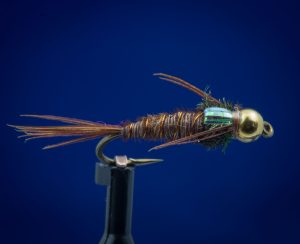
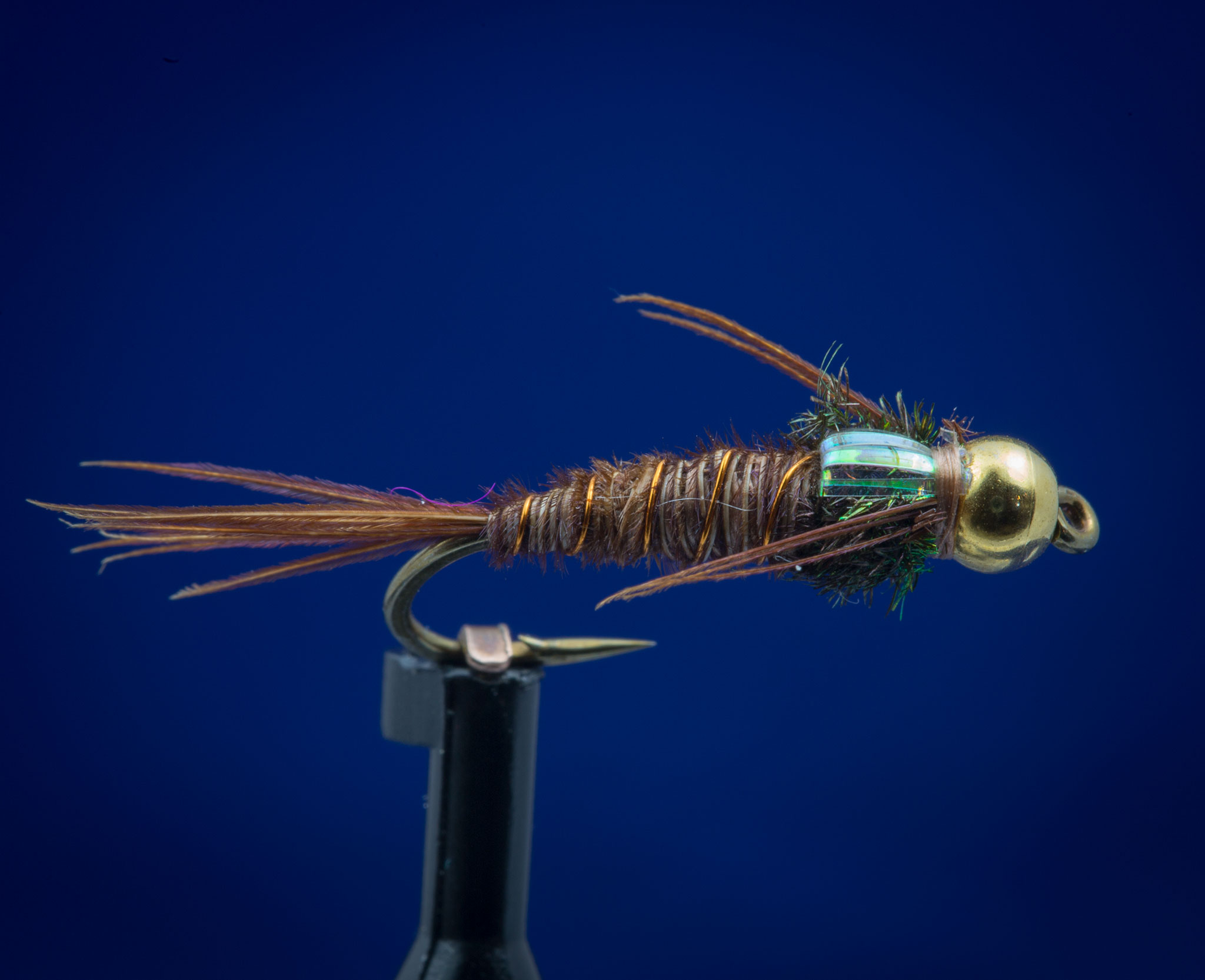
If I had to reduce my nymph selection to one pattern, the version of the pheasant tail would be very difficult to leave behind. The beadhead flashback shown here, works the world over. Its general shape suggests a range of mayfly nymphs, the bead helps it sink, and the flashback gives it a little visibility without overwhelming the rest of the fly. It is a straightforward pattern that can be adapted to a great deal of ordinary river fishing, which is precisely what I want from something I carry everywhere I go.
It works beneath an indicator, under a suitable dry or as part of a tightline presentation. That flexibility allows the approach to change without necessarily changing the pattern. Once you know a nymph well, you can spend more time considering whether it is reaching the fish and drifting properly, rather than immediately assuming you have tied on the wrong thing. The pheasant tail has earned that sort of confidence from me through repeated use, not through any particularly convincing explanation of why it ought to work.
Chernobyl Ant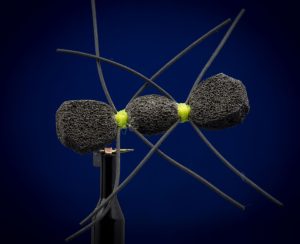

A beginner can be forgiven for looking at a Chernobyl Ant and wondering what it is supposed to represent. It is a substantial piece of foam with very little interest in looking anatomically correct. Yet put it into suitable water and trout can respond with an enthusiasm that makes the question seem less important. In summer, particularly around banks and cover where terrestrial insects enter the river, it gives a fish something conspicuous to investigate.
I like it around undercut banks, overhanging vegetation and broken bankside water. I’ll just as happily float it down a deep pool and skate it out from cover. It’s also useful when teaching because the angler can usually keep track of it, it floats like a cork, and there is often little ambiguity about the take. Some of my favourite fishing involves presenting a large foam fly into an awkward pocket that looks barely capable of holding a trout, then watching a fish appear from out of nowhere. The Chernobyl is not subtle, but subtlety is not the requirement in every piece of water.
Parachute Adams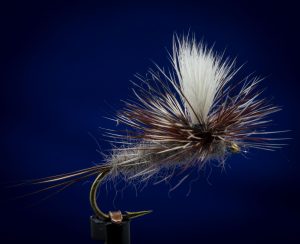

The Parachute Adams is one of the most useful general-purpose dry flies I carry. In different sizes it can suggest a range of mayflies and smaller insects without needing to be an exact copy of any one of them. Its low position in the surface film is part of its appeal, while the visible post gives the angler a reasonable chance of following what the fly is doing. That combination matters when you are trying to judge a drift rather than simply hope it is behaving.
It is a very different choice from the larger attractors. Where a Royal Wulff helps me search broken water, the Parachute Adams gives me a more restrained option for fish feeding at the surface. There will be times when a more specific imitation is required, but I am happy to begin with something familiar and watch the response. A sensible sized PA and a clean drift can answer a fair number of questions before the rest of the fly box needs to be opened.
Bubbleback Pupa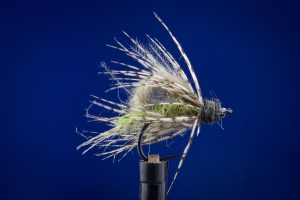
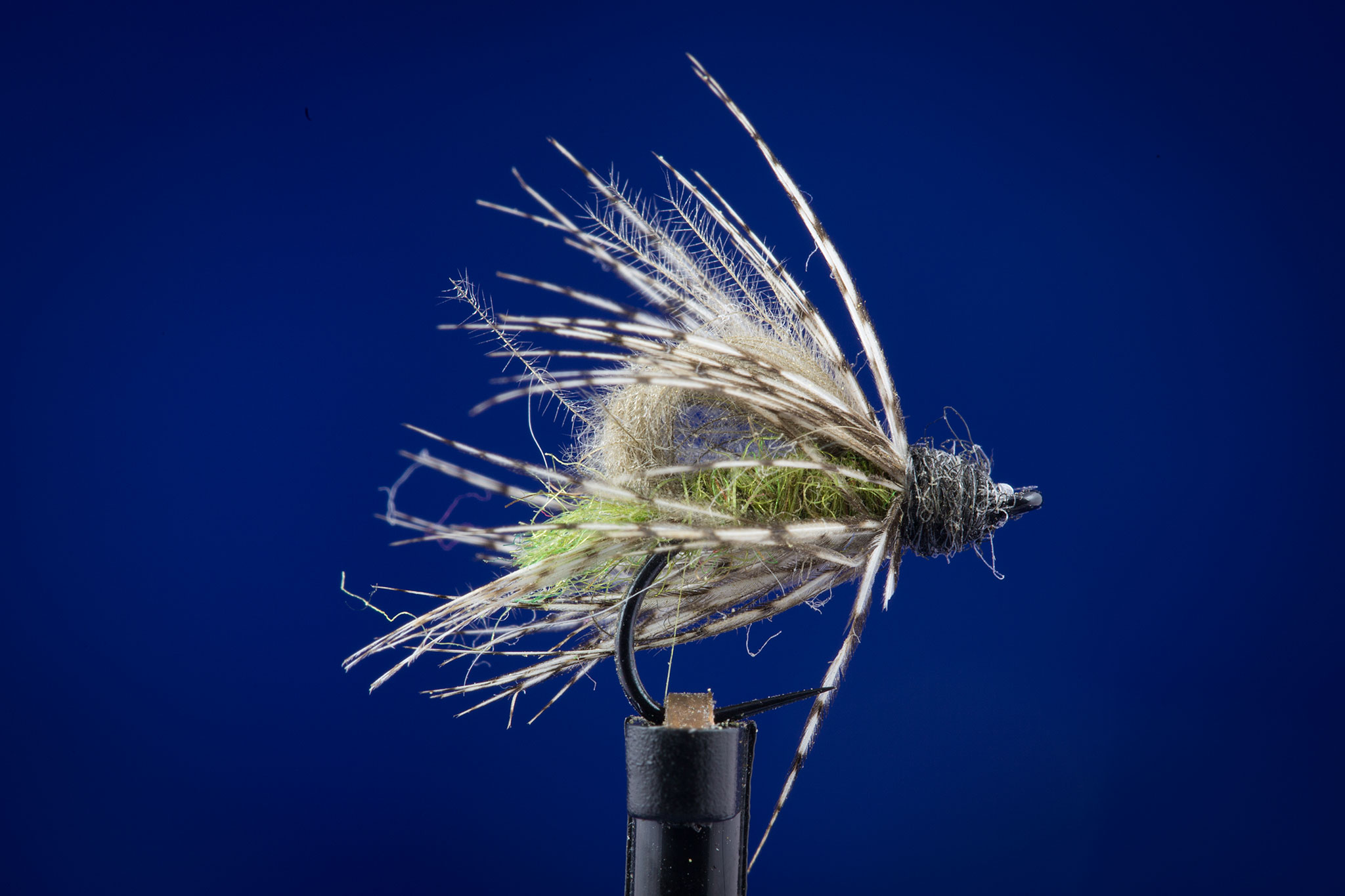
René Harrop’s Bubbleback Pupa is a useful pattern when caddis activity has the fish feeding beneath the surface. The reflective back is intended to suggest the gas associated with an emerging pupa, giving the fly something of the appearance of an insect ascending through the water. It is an understated pattern compared with the larger attractors, but its purpose is different. You are offering something relevant to fish already occupied with a particular stage of the hatch.
This is where watching matters more than changing flies at random. Caddis may be visible above the water while the trout are concentrating on what is happening underneath. A dry fly can seem the obvious choice to the angler without being the best representation of what the fish are eating. The Bubbleback gives me an option for that situation. Its usefulness depends on presenting it where the fish are feeding, rather than assuming that tying on a convincing pattern has completed the job. Often fished in tandem with an adult caddis pattern.
Copper John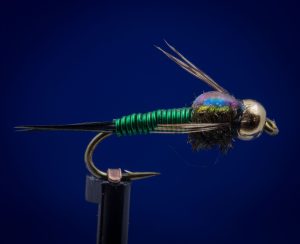
The Copper John is a practical nymph for water where getting the fly down is a significant part of the problem. John Barr’s pattern combines weight with a relatively slim profile, making it useful in faster runs, deeper slots and heavier current. There are plenty of occasions when a fly that looks perfectly suitable is simply not spending enough time at the required depth. The Copper John gives me another way to address that without abandoning a recognisable nymph shape.
I value it particularly when the fishing has been difficult and we need to work through the deeper water properly. That does not mean putting one on guarantees a change in fortune. It means choosing a fly whose weight and profile suit the job, then giving it a useful drift. Its appeal is straightforward: it gets down, attracts attention and catches trout. There is considerable comfort in having a few patterns whose purpose you can explain without making them sound revolutionary. It also works in tiny sizes #20 fished six to ten inches beneath a dry.
Klinkhammer
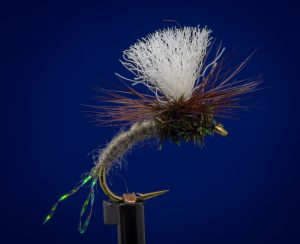
The Klinkhammer makes sense once you begin looking closely at what a rise actually represents. A fish showing near the surface is not necessarily taking a fully emerged insect floating on top. It may be feeding on something caught in the process of emerging, with much of its body still below the film. The Klinkhammer’s curved hook allows the body to hang beneath the surface while the upper part remains supported, presenting a different profile from a conventional dry.
That position is the reason I carry it. When trout are interested in vulnerable insects at the surface rather than adults riding neatly above it, the way a fly sits can matter a great deal. Thinking about that also improves the way you watch fish. Instead of seeing a disturbance and immediately reaching for any dry, you begin considering where the insect is and how it is sitting in the water. The Klinkhammer gives you a useful starting option once you have made that distinction.
Royal Stimulator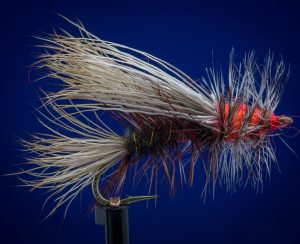

The Royal Stimulator shares some of the Royal Wulff’s practical virtues: it is visible, buoyant and well suited to broken water. It sits somewhere between a stonefly suggestion and an attractor, offering a substantial surface presence without depending on an exact match. I particularly like it in faster freestone water and smaller mountain streams, where being able to follow the fly through successive pockets makes the fishing easier to manage.
It is also a useful top fly in a dry-dropper arrangement. The buoyancy helps support a nymph beneath it, while the dry remains a worthwhile offering in its own right. That last part is easy to forget when you have become absorbed in watching it as an indicator. A trout charging up through broken water to eat the Stimulator is a useful reminder that both flies are fishing. It gives you a surface opportunity while allowing the nymph to work below, which is often a sensible way to search.
Bushy’s Emerger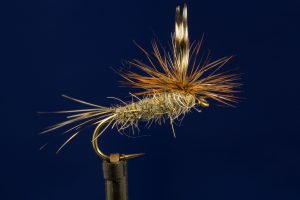

Bushy’s Emerger is at the quieter end of this selection. Kaj Busch’s pattern relies on its silhouette and position in the film rather than the visibility and bulk of the attractor dries. It is one I like for selective trout feeding calmly in clear water, particularly during difficult mayfly activity when a more heavily hackled fly does not seem to interest them. Under an overcast sky, with fish feeding steadily but refusing a succession of presentations, it is a pattern worth having available.
The important thing is not to treat it as a solution that excuses everything else. It still needs a careful approach, a suitable leader/tippet and a natural drift. A subtle fly pulled across the current is not suddenly convincing because it’s a nicer tie. What I like about Bushy’s Emerger is that it gives me a restrained option to flies like the Parachute Adams. It belongs in the box for different reasons to many of the flies on this list, and there are days when that difference matters enormously.
Knowing the Flies You Carry
What I value about this selection is that the patterns all do different jobs well. Some remain visible and afloat in broken water. Others sit low in the film or fish beneath it. A few provide weight, while others offer a conspicuous mouthful along a summer bank. Knowing those differences is more useful than deciding that one of them must be the best fly and expecting it to suit every situation.
Confidence helps, but it should leave room for the fish to tell you something. There is no virtue in persisting with a favourite when the evidence points elsewhere. Equally, changing patterns every fifteen minutes can prevent you from noticing that the problem is your position, the leader or the depth. I would rather make a considered change for a reason than work through the box until something happens and call that understanding.
I will keep trying new flies because I enjoy tying them, and occasionally one earns a regular place. In the meantime, these are among the patterns I am happy to put on a client’s leader and give a proper chance. I know what I am asking them to do. That leaves us free to concentrate on the part that still needs working out: where the trout is feeding and how to get the fly there without giving the game away.
Ant